Best for viewers who enjoy crime films where dialogue carries as much weight as action, and who respond to nonlinear storytelling that rewards attention rather than punishing it.
Crime Classic
Pulp Fiction
Three stories, one night, and a timeline that refuses to sit still.
The film that made crime dialogue sound like jazz.
Editorial Verdict
Why Pulp Fiction Is Worth Your Time
Pulp Fiction is the kind of film that makes you forget other movies exist while it is running. Tarantino does not just break the timeline - he rebuilds it so that every ending is also a beginning, every conversation that feels like a digression actually sets a trap, and every character you think is secondary turns out to be holding a piece of the same puzzle. Samuel L. Jackson delivers what may be the most quotable performance in modern cinema, but the real achievement is the rhythm: the film moves at the speed of its own confidence and never once asks permission.
The diner bookend structure is the film's quietest architectural move. The opening scene with Pumpkin and Honey Bunny seems like a tangent until the ending reveals that Jules and Vincent are sitting at the next table. The loop closes, and the film suddenly feels smaller and more intentional than it did two and a half hours ago.
The soundtrack is not a score in the traditional sense. It is a curated playlist that tells you who these people are. Surf rock for Vincent's drive to Mia's house. Soul music for the twist contest at Jack Rabbit Slim's. The needle drops are not background. They are character notes.
Why This Movie Works
- The non-linear structure is not decoration. It fundamentally changes how you process the story. Seeing Jules survive a situation before you understand why gives his later philosophical turn a weight that straight chronology could not match.
- The dialogue operates on a frequency that no mainstream crime film had reached before. Conversations about burgers, foot massages, and television pilots are not filler - they are the film's entire personality. Tarantino trusts that people talking is as gripping as people shooting.
- Samuel L. Jackson's Ezekiel 25:17 speech is famous, but the quieter moment in the diner, when Jules decides to walk away from the life, is where the performance actually earns its place in film history. He goes from certainty to doubt in one conversation.
Where It Falls Short
- The film's influence has been so widely copied that its original innovations can feel familiar to modern viewers who have absorbed thirty years of Tarantino imitators without ever seeing the source.
- Some supporting threads, particularly the gimp sequence, land more as shock value than as narrative necessity. It is memorable, but it does not carry the same structural weight as the Jules, Vincent, or Butch storylines.
Movie Guide
What To Know Before Watching Pulp Fiction
This section combines verified production facts with original editorial context so the page works as a viewing guide for readers approaching one of the most influential crime films ever made.
Official Synopsis
Los Angeles criminal underworld connects the lives of two philosophical hit men, a fading boxer, a gangster's restless wife, and a pair of small-time diner robbers. Vincent Vega is tasked with keeping Mia Wallace entertained while her husband Marsellus is out of town. Butch Coolidge accepts money to lose a fight and then decides to keep the money and run. Jules Winnfield begins questioning his life after what he considers a divine intervention. These threads do not run parallel. They crash into each other, and the collisions are the entire point of the film.
The synopsis outlines the intersecting storylines, but the real draw is how Tarantino arranges them. The film does not follow cause and effect in the order you expect. It loops, doubles back, and lets you see consequences before you understand the causes.
That structural choice is not a gimmick. It reframes how you read every scene. Jules' philosophical crisis hits differently when you know where his story ends. Butch's escape carries more weight when you already saw the aftermath.
Source: Miramax Films, A Band Apart, Academy Awards records, and supporting factual references for this review
Why This Movie Stands Out
Pulp Fiction works because it treats pop culture as the operating system its characters think through. They do not discuss philosophy or theology. They discuss what kind of burger comes with what sauce, what a foot massage means, and whether a television pilot got picked up. These are not jokes. They are the film's thesis: people build their world out of the media they consume.
The diner bookend structure is the film's quietest architectural move. The opening scene with Pumpkin and Honey Bunny seems like a tangent until the ending reveals that Jules and Vincent are sitting at the next table. The loop closes, and the film suddenly feels smaller and more intentional than it did two and a half hours ago.
John Travolta's casting was a risk that redefined a career. In 1994, he was a television actor known for a past decade. Tarantino saw something in him that the industry had written off, and Vincent Vega became the vehicle for Travolta's second act. The performance is loose, slightly detached, and exactly right for a man who is coasting through his own life.
Butch's storyline is the film's most traditionally narrative thread, and that is why it sits in the middle of the structure like an anchor. The gold watch, the pawn shop, the choice to go back and save Marsellus - these are classical story beats wrapped in a film that mostly rejects them. The contrast is deliberate.
The soundtrack is not a score in the traditional sense. It is a curated playlist that tells you who these people are. Surf rock for Vincent's drive to Mia's house. Soul music for the twist contest at Jack Rabbit Slim's. The needle drops are not background. They are character notes.
Mia Wallace appears in one main storyline, yet Uma Thurman's presence stretches across the entire film. She is the danger you cannot quite see coming. The overdose sequence is one of the most tense scenes Tarantino ever directed because it strips away every joke and every cultural reference and leaves only panic and a man who needs to solve an impossible problem in sixty seconds.
The $8 million budget against $213.9 million worldwide remains one of the most profitable ratios in modern cinema history. But the financial story is secondary to the industrial one. Pulp Fiction proved that an independent film with a fractured timeline, minimal action set pieces, and conversations about nothing could outgross studio releases with ten times the budget.
Andrzej Sekula's cinematography gets overshadowed by the dialogue, but the visual language matters. The film looks like a pulp magazine brought to life - saturated colors, sharp shadows, and compositions that treat every interior space like a photograph from a men's adventure paperback. It is not realistic. It is heightened.
Deep Dive
What Pulp Fiction Is Really Doing
This is where Pulp Fiction stops being just a crime movie and becomes a meditation on choice, consequence, and the way pop culture language - from fast food to television pilots - shapes how people think about their own lives.
The Emotional Center
Pulp Fiction works because it treats pop culture as the operating system its characters think through. They do not discuss philosophy or theology. They discuss what kind of burger comes with what sauce, what a foot massage means, and whether a television pilot got picked up. These are not jokes. They are the film's thesis: people build their world out of the media they consume.
The dialogue operates on a frequency that no mainstream crime film had reached before. Conversations about burgers, foot massages, and television pilots are not filler - they are the film's entire personality. Tarantino trusts that people talking is as gripping as people shooting.
Why The World Feels Distinct
The non-linear structure is not decoration. It fundamentally changes how you process the story. Seeing Jules survive a situation before you understand why gives his later philosophical turn a weight that straight chronology could not match.
Butch's storyline is the film's most traditionally narrative thread, and that is why it sits in the middle of the structure like an anchor. The gold watch, the pawn shop, the choice to go back and save Marsellus - these are classical story beats wrapped in a film that mostly rejects them. The contrast is deliberate.
Mia Wallace appears in one main storyline, yet Uma Thurman's presence stretches across the entire film. She is the danger you cannot quite see coming. The overdose sequence is one of the most tense scenes Tarantino ever directed because it strips away every joke and every cultural reference and leaves only panic and a man who needs to solve an impossible problem in sixty seconds.
Where Some Viewers May Pull Back
The film's influence has been so widely copied that its original innovations can feel familiar to modern viewers who have absorbed thirty years of Tarantino imitators without ever seeing the source.
Some supporting threads, particularly the gimp sequence, land more as shock value than as narrative necessity. It is memorable, but it does not carry the same structural weight as the Jules, Vincent, or Butch storylines.
Best for viewers who enjoy crime films where dialogue carries as much weight as action, and who respond to nonlinear storytelling that rewards attention rather than punishing it.
Official Trailer
Watch Pulp Fiction Trailer
Visuals
Scenes, Atmosphere, And Key Visuals
These images keep the page close to the movie itself, not just to a text summary.
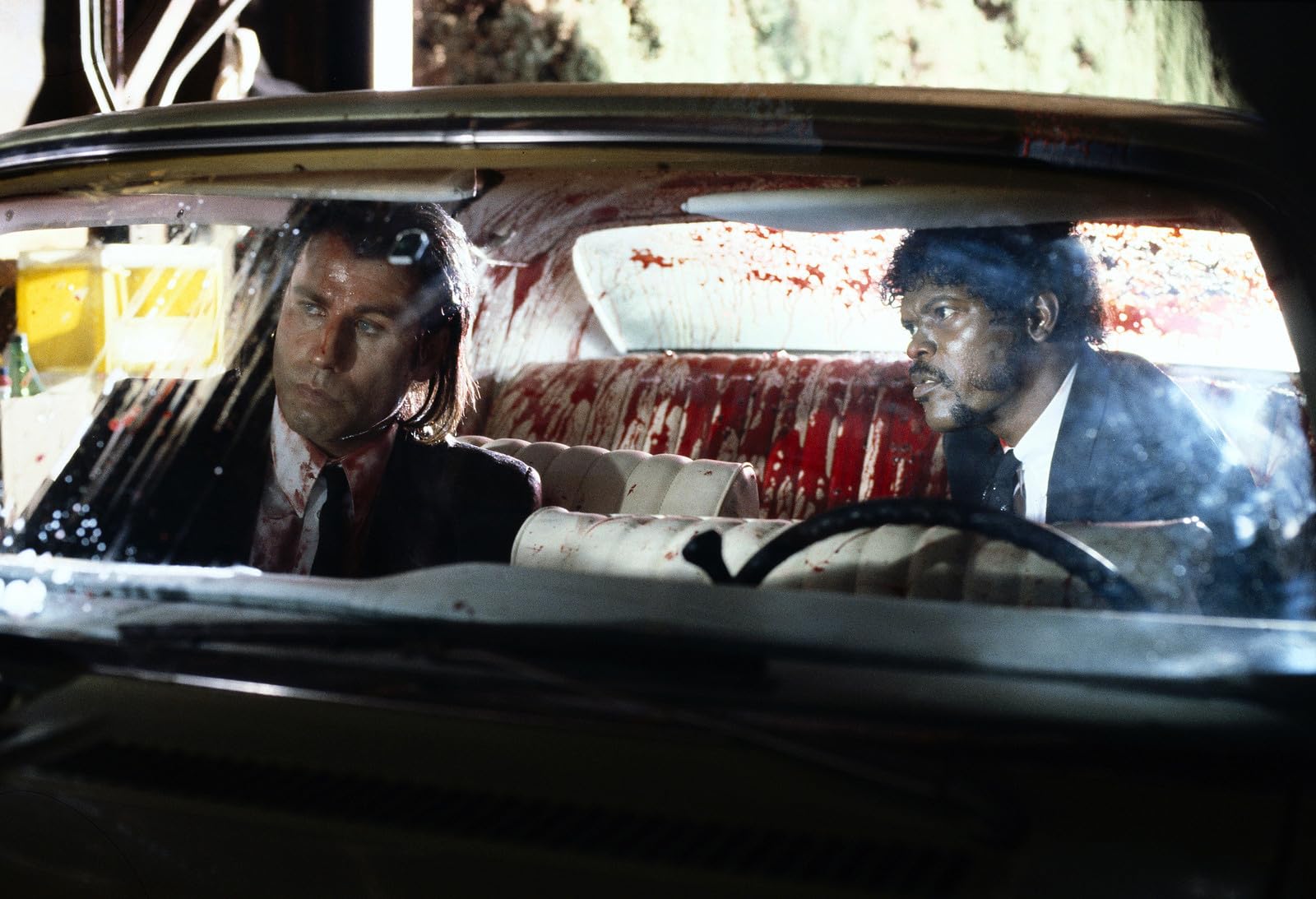
Main Cast
The ensemble is built around career-defining turns. Travolta was considered washed before this film. Jackson became the most recognizable voice in American cinema. Thurman turned one dinner scene into an icon.
- John Travolta
- Samuel L. Jackson
- Uma Thurman
- Bruce Willis
- Ving Rhames
- Harvey Keitel
- Tim Roth
- Amanda Plummer
Awards And Recognition
Pulp Fiction won the Palme d'Or at Cannes and the Academy Award for Best Original Screenplay. It was nominated for seven Oscars total. The Cannes victory, announced in May 1994, is what turned the October release into a cultural event.
- Palme d'Or - Cannes Film Festival 1994
- Academy Award for Best Original Screenplay (Quentin Tarantino, Roger Avary)
- 7 Academy Award nominations including Best Picture, Best Director, Best Actor (Jackson)
- BAFTA Award for Best Original Screenplay, Independent Spirit Award for Best Feature
FAQ
Questions Readers Usually Have
These questions focus on the things readers usually want answered before watching: timeline structure, violence level, whether it holds up decades later, and what kind of viewer connects with it most.
Is Pulp Fiction based on a true story?
No. It is an original screenplay by Quentin Tarantino and Roger Avary. The stories, characters, and events are entirely fictional, though they draw inspiration from pulp crime magazines and B-movies of the 1970s.
How long is Pulp Fiction?
The theatrical runtime is 2 hours and 34 minutes. There is no extended cut - the theatrical version is the only version.
Why is the story told out of order?
Tarantino rearranged the timeline to create dramatic irony and thematic resonance. You see the aftermath before you understand the cause, which changes how you read every scene. It is a structural choice that makes the film about fate and consequence rather than simple plot progression.
How violent is it compared to modern films?
The violence is intense but stylized. It is not graphic in the way many modern films are, but it is sudden, unpredictable, and emotionally charged. The R rating reflects strong language, drug use, and sexual content as much as the violence itself.
Do I need to watch other Tarantino films first?
No. Pulp Fiction is completely standalone. It is not connected to Reservoir Dogs, Jackie Brown, or any other Tarantino film in terms of plot.
What awards did it win?
It won the Palme d'Or at the 1994 Cannes Film Festival and the Academy Award for Best Original Screenplay. It was nominated for seven Oscars total including Best Picture, Best Director, and Best Actor for Samuel L. Jackson.
Does it still hold up today?
The dialogue-driven approach and the nonlinear structure influenced an entire generation of filmmakers, which means some of its innovations now feel familiar. But the film's confidence, rhythm, and performances remain distinctive enough that it plays as strongly now as it did in 1994.
What kind of viewer will enjoy this most?
Viewers who like crime films where conversation is as important as action, who enjoy piecing together a fractured timeline, and who respond to movies with a clear authorial voice. If you prefer straightforward narratives, the structure may feel more frustrating than rewarding.
What is the significance of the title?
"Pulp fiction" refers to cheap, sensational crime magazines printed on rough wood pulp paper in the mid-twentieth century. The film is Tarantino's homage to that tradition - pulp stories elevated to high art through structure, dialogue, and casting.