Best for viewers who want animated cinema with real moral weight, mythic scale, and environmental themes that do not reduce themselves to slogans.
Animation Epic
Princess Mononoke
Miyazaki's most morally ambitious film ÔÇö a war story where every side believes it is right.
A young prince carrying a deadly curse wanders into a war between a mining colony and the gods of the forest.
Editorial Verdict
Why Princess Mononoke Is Worth Your Time
Princess Mononoke works because Miyazaki treats both sides of the conflict as defensible and both as destructive. He does not flatten the story into a simple environmental parable. The film carries the weight of real disagreement between people trying to survive, and that tension gives the movie a rare moral seriousness for animation.
Ashitaka works as a protagonist because he does not want to win. He wants the fighting to stop, which is a very different goal and one that puts him in conflict with every faction. His curse is not just a plot device ÔÇö it is a physical representation of how hatred consumes the person carrying it, and the animation of the curse tendrils is one of the most visually disturbing elements in any Ghibli film.
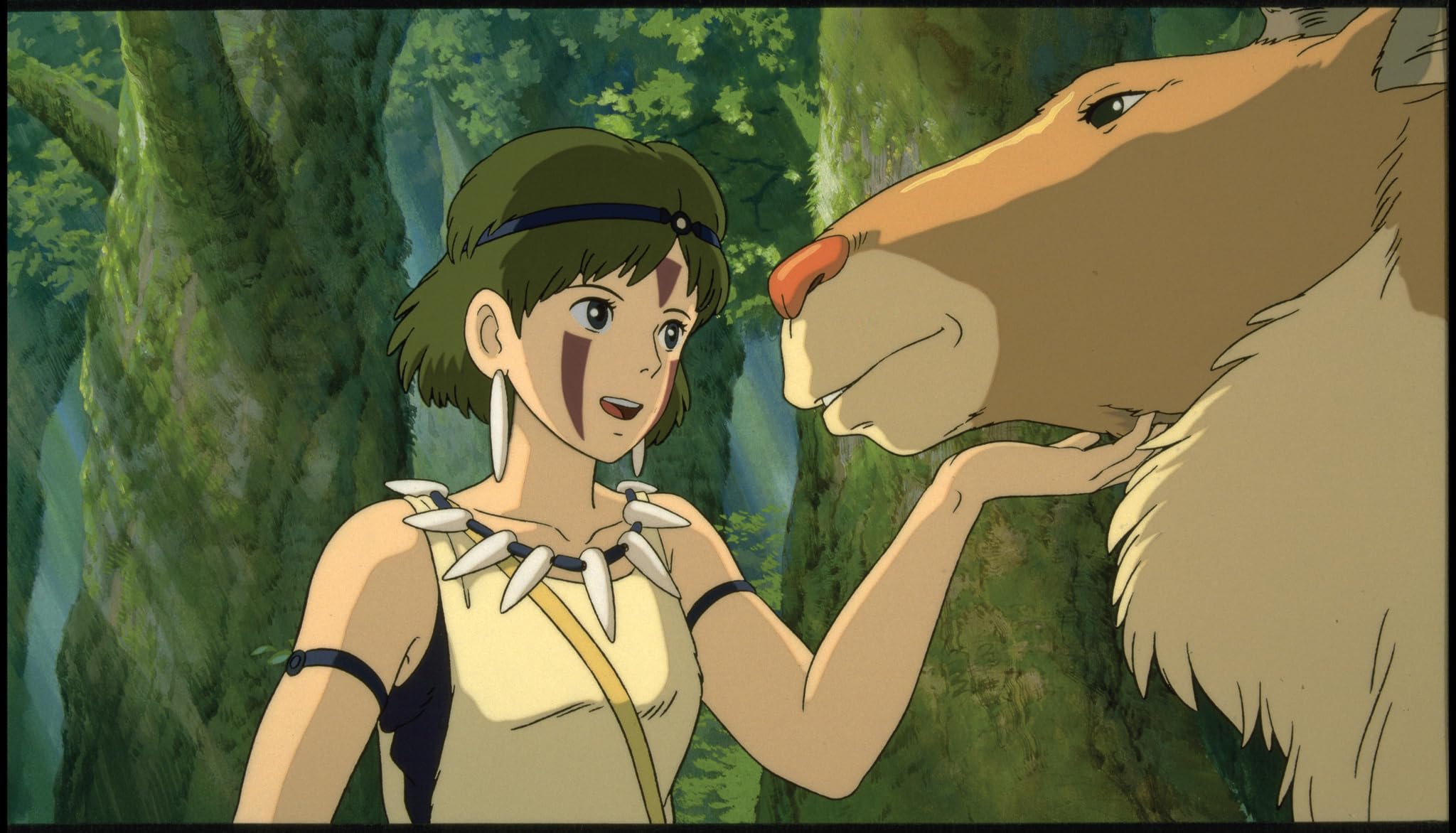
Visually, the film sits at the peak of Studio Ghibli's cel animation period. The backgrounds are painted with the kind of density that rewards pausing on any frame, and the character animation is fluid enough to carry emotional weight in gestures alone. This was one of the last major hand-drawn epics before the industry shifted heavily to digital, and it shows in the warmth and imperfection of the image.
Why This Movie Works
- Miyazaki refuses to flatten the conflict into a simple good-versus-evil narrative. Lady Eboshi is genuinely cruel to the forest but genuinely compassionate to her people, and the film respects both truths at once.
- The animation still holds up because the hand-painted backgrounds and cel-shaded characters carry a physical texture that digital-only films from the same era have already lost.
- Joe Hisaishi's score is one of the most emotionally direct in anime. It does not try to be clever ÔÇö it pushes the heart of the scene forward and stays out of the way when silence would be stronger.
Where It Falls Short
- The film tries to hold so many moral positions at once that the middle act can feel overstuffed, with new factions and gods arriving faster than the narrative fully absorbs the last one.
- Viewers who need clear resolution and identifiable winners will probably find the ending frustrating. Miyazaki chooses uneasy balance over closure, and that is a deliberate cost.
Movie Guide
What To Know Before Watching Princess Mononoke
The facts below establish the scale of Miyazaki's production, but the review needs to stay focused on what the movie actually argues about conflict and survival.
Official Synopsis
While seeking to cure himself of a curse placed on him by a dying boar god, the young Emishi prince Ashitaka travels west and becomes entangled in a war between Irontown, a human settlement led by the ambitious Lady Eboshi, and the forest deities who are losing their home to her ironworks. There he meets San, a young woman raised by the wolf goddess Moro, who fights on the side of the forest. Ashitaka tries to find a path that does not end in total destruction for either side.
The synopsis gives you the shape of the war, but the review should make clear that Miyazaki refuses to hand the reader a winner. Every faction believes it is right, and the film respects that conviction even as it shows the damage it causes.
That ambiguity is where the page adds real value. The review should help readers understand why the film's refusal to simplify its conflict is its greatest strength and why that same quality can make the experience feel heavy for viewers looking for cleaner resolution.
Source: Studio Ghibli production records, Miyazaki interviews, and supporting factual references for this review
Why This Movie Stands Out
Princess Mononoke is often described as an environmental film, but that label flattens what Miyazaki is actually doing. The forest gods are not innocent ÔÇö they are furious, territorial, and willing to kill humans on sight. The humans are not cartoon exploiters either ÔÇö they are refugees, former prostitutes, and lepers who found dignity through labor. The movie is not asking who is right. It is asking what happens when two survival projects collide.
Ashitaka works as a protagonist because he does not want to win. He wants the fighting to stop, which is a very different goal and one that puts him in conflict with every faction. His curse is not just a plot device ÔÇö it is a physical representation of how hatred consumes the person carrying it, and the animation of the curse tendrils is one of the most visually disturbing elements in any Ghibli film.
San and Eboshi are the two gravitational centers of the film, and Miyazaki is unusually careful with both. San is fierce and uncompromising, but she is also emotionally stunted by her isolation and her inability to process the fact that she is human. Eboshi is a social reformer and an ecological destroyer at the same time, and the film does not ask the viewer to subtract one from the other.
The Forest Spirit itself is the most conceptually interesting element in the movie. It gives and takes life with the same indifference, and the climax of the film is not a battle for victory but a desperate attempt to return something that was taken out of balance. The Night-Walker sequence is one of the most quietly devastating animated scenes ever put to film because it does not dramatize destruction ÔÇö it just shows life draining out of a landscape.
Visually, the film sits at the peak of Studio Ghibli's cel animation period. The backgrounds are painted with the kind of density that rewards pausing on any frame, and the character animation is fluid enough to carry emotional weight in gestures alone. This was one of the last major hand-drawn epics before the industry shifted heavily to digital, and it shows in the warmth and imperfection of the image.
The English dub, produced by Miramax and overseen by Neil Gaiman for the script adaptation, is serviceable but uneven. Billy Crudup and Minnie Driver do solid work, but the original Japanese performances by Yoji Matsuda and Yuriko Ishida carry a sharper emotional register. The dub is perfectly watchable, but the Japanese track is the stronger recommendation for a first viewing.
The film's commercial success in Japan ÔÇö holding the box office record until Titanic ÔÇö is often mentioned but rarely contextualized. This is not a family-friendly cartoon that accidentally drew adults. It is a film with beheadings, a plague curse, and a moral argument about industrialization, and it still packed theaters. That fact alone tells you something about the ambition of the project.
For viewers new to Miyazaki, this is not the gentle entry point that My Neighbor Totoro offers. It is closer to a war film dressed in mythological clothing. That matters because the audience fit is narrower ÔÇö younger children will struggle with the violence and the pacing, while older viewers who can sit with ambiguity will probably find the film rewarding on repeat viewings.
Deep Dive
What Princess Mononoke Is Really Doing
This is where Princess Mononoke stops being just a war story and becomes a meditation on how people justify harm when they believe their cause is righteous. The film is unusually resistant to easy answers.
The Emotional Center
Princess Mononoke is often described as an environmental film, but that label flattens what Miyazaki is actually doing. The forest gods are not innocent ÔÇö they are furious, territorial, and willing to kill humans on sight. The humans are not cartoon exploiters either ÔÇö they are refugees, former prostitutes, and lepers who found dignity through labor. The movie is not asking who is right. It is asking what happens when two survival projects collide.
The animation still holds up because the hand-painted backgrounds and cel-shaded characters carry a physical texture that digital-only films from the same era have already lost.
Why The World Feels Distinct
Miyazaki refuses to flatten the conflict into a simple good-versus-evil narrative. Lady Eboshi is genuinely cruel to the forest but genuinely compassionate to her people, and the film respects both truths at once.
The Forest Spirit itself is the most conceptually interesting element in the movie. It gives and takes life with the same indifference, and the climax of the film is not a battle for victory but a desperate attempt to return something that was taken out of balance. The Night-Walker sequence is one of the most quietly devastating animated scenes ever put to film because it does not dramatize destruction ÔÇö it just shows life draining out of a landscape.
The English dub, produced by Miramax and overseen by Neil Gaiman for the script adaptation, is serviceable but uneven. Billy Crudup and Minnie Driver do solid work, but the original Japanese performances by Yoji Matsuda and Yuriko Ishida carry a sharper emotional register. The dub is perfectly watchable, but the Japanese track is the stronger recommendation for a first viewing.
Where Some Viewers May Pull Back
The film tries to hold so many moral positions at once that the middle act can feel overstuffed, with new factions and gods arriving faster than the narrative fully absorbs the last one.
Viewers who need clear resolution and identifiable winners will probably find the ending frustrating. Miyazaki chooses uneasy balance over closure, and that is a deliberate cost.
Best for viewers who want animated cinema with real moral weight, mythic scale, and environmental themes that do not reduce themselves to slogans.
Official Trailer
Watch Princess Mononoke Trailer
Visuals
Scenes, Atmosphere, And Key Visuals
These images keep the page close to the movie itself, not just to a text summary.
Main Cast
The voice performances matter because they are the emotional bridge between a world of forest gods and human ambition. The cast has to sell both the mythic and the political without tipping the film into either extreme.
- Yoji Matsuda
- Yuriko Ishida
- Yuko Tanaka
- Kaoru Kobayashi
- Akihiro Miwa
- Masahiko Nishimura
- Mitsuko Mori
- Hisaya Morishige
Awards And Recognition
Princess Mononoke was the highest-grossing film in Japan until Titanic claimed the record a few months later. The recognition it earned was not just commercial ÔÇö it proved that animation could carry adult moral complexity and still draw mass audiences.
- Best Picture at the 21st Japan Academy Prize (1998)
- Highest-grossing film in Japan until Titanic displaced it in 1998
- Pioneered digital compositing in hand-drawn anime, influencing a generation of Japanese filmmakers
FAQ
Questions Readers Usually Have
These questions focus on the things readers usually want answered before watching: tone, violence level, whether prior Ghibli knowledge is needed, and whether the film works as a standalone experience.
How long is Princess Mononoke?
The runtime is 2 hours and 14 minutes (134 minutes), making it one of the longer Studio Ghibli films.
Who directed Princess Mononoke?
Hayao Miyazaki wrote and directed the film. It was produced by Toshio Suzuki and animated by Studio Ghibli.
Is Princess Mononoke appropriate for children?
It carries a PG-13 rating for images of violence and gore. Beheadings, blood, a plague curse, and intense battle sequences appear throughout. This is not a gentle family film in the way that My Neighbor Totoro is. Older children 12 and up may handle it, but younger viewers will likely find it too heavy.
Do I need to watch other Ghibli films to understand this one?
No. Princess Mononoke is entirely self-contained. Prior exposure to Studio Ghibli is not required and will not change what is happening on screen.
Should I watch the Japanese or English version?
The Japanese version is recommended for a first viewing. The English dub, featuring voices like Billy Crudup and Minnie Driver, is competent, but the original Japanese performances carry a sharper emotional register. You can rewatch with the dub if you prefer.
What is the movie really about?
At its core, the film is about what happens when two groups that both believe they are right collide. It is not simply nature versus industry. Lady Eboshi is protecting marginalized people while destroying the forest, and the forest gods are defending their home while killing humans indiscriminately. Miyazaki is interested in that contradiction, not in resolving it.
Does the movie have a happy ending?
It has an honest ending. The immediate crisis is resolved, but the forest is not fully restored and the war is not decisively won. Miyazaki chooses balance over victory, which some viewers find satisfying and others find incomplete.
Is Princess Mononoke better than Spirited Away?
That depends on what you are looking for. Spirited Away is more whimsical, more personal, and more accessible on a first watch. Princess Mononoke is larger, more political, and more willing to sit with uncomfortable moral questions. Neither is objectively superior ÔÇö they aim at different targets.
Is it worth watching on a large screen?
Yes. The hand-painted backgrounds, the scope of the landscapes, and the detail in the animation all benefit from a bigger frame. If you have the option between a phone and a TV, take the TV.
What kind of action does the film contain?
The action is sword-and-arrow combat, supernatural attacks, and large-scale battle sequences. It is animated but not bloodless. Characters are dismembered, and the curse sequences are deliberately unsettling. The violence serves the story, but it is not softened for the medium.