Best for viewers who can handle uncompromising material and who want to understand why this film is still the benchmark for historical drama done responsibly.
Historical Essential
Schindler's List
Spielberg strips away color and comfort to confront one of the darkest chapters of the twentieth century.
A businessman arrives to profit from war and stays to buy back lives.
Editorial Verdict
Why Schindler's List Is Worth Your Time
Schindler's List is the kind of film that makes every other movie on this site feel smaller without diminishing what they do. Spielberg strips away color, score manipulation in most scenes, and any comfort a viewer might seek, and then he forces you to sit with what is happening. Liam Neeson gives one of his finest performances as a man who arrives to profit from war and ends up spending everything he has to stop it from taking more lives. Ralph Fiennes is genuinely terrifying as Amon Goeth, not because he shouts, but because he does not need to.
Spielberg made the decision to shoot on location in Poland, including at Auschwitz-Birkenau itself. This is not recreation. The geography is real. The buildings Schindler walks through are the buildings where these things happened. That choice gives the film a gravitational pull that no soundstage could match.
Ben Kingsley as Itzhak Stern is the quiet engine of the film. He is the one who keeps the lists, who manages the numbers, who understands that every integer is a person. Stern is not loud. He is precise. And in a film about the value of human life, precision is its own form of courage.
Why This Movie Works
- Steven Spielberg shoots in black and white with a documentary sensibility that refuses to aestheticize suffering. The decision to shoot without color is not a stylistic gimmick - it makes the images harder to dismiss as cinema.
- Ralph Fiennes as Amon Goeth is one of the most honest portray of evil ever put on screen. He does not growl or posture. He shoots people from his balcony in a bathrobe before breakfast. That casualness is the point.
- The girl in the red coat is one of the few uses of color in the entire film, and it works because Spielberg deploys it once, lets it register, and then never uses it again. The image of her body on a cart later does the talking.
Where It Falls Short
- At three hours and fifteen minutes, the film demands patience. The runtime is justified by the material, but it remains a commitment that some viewers will find draining rather than captivating.
- The framing device at the end, with real Schindler Jews visiting Oskar's grave, breaks the cinematic spell. Some find it essential. Others feel it pulls them out of the film's constructed world.
Movie Guide
What To Know Before Watching Schindler's List
This section combines verified production facts with original editorial context so the page works as a viewing guide for readers approaching one of the most important films ever made.
Official Synopsis
In Krakow during the Nazi occupation, Oskar Schindler, a German businessman and member of the Nazi party, arrives looking for profit. He acquires a factory, hires an accountant named Itzhak Stern to manage operations, and fills his workforce with Jewish laborers from the local ghetto. What begins as opportunism shifts into something heavier as Schindler watches the liquidation of the ghetto from a hillside, sees the random cruelty of camp commandant Amon Goeth, and realizes that the people on his employment list are not tools for wealth - they are the only thing standing between him and a war crime he refuses to be complicit in. He begins buying lives.
The synopsis outlines Schindler's transformation, but the real story is about how ordinary people behave when the world around them has lost its moral center. Schindler is not a saint. He starts as an opportunist. That is exactly what makes his arc matter.
The parallel with Amon Goeth is the film's structural backbone. Two men with power over the same population, and the choices they make under that power are the distance between rescue and annihilation.
Source: Universal Pictures, Amblin Entertainment, Academy Awards records, and supporting factual references for this review
Why This Movie Stands Out
Schindler's List works because it understands that the Holocaust is not a story about one hero. It is a story about a system, the people who operated it, the people who survived it, and the very few who tried to bend it toward mercy. Schindler is not pure. He drinks, he cheats, he profits from slave labor early on. The film does not sanitize him. It respects him because he changes.
Spielberg made the decision to shoot on location in Poland, including at Auschwitz-Birkenau itself. This is not recreation. The geography is real. The buildings Schindler walks through are the buildings where these things happened. That choice gives the film a gravitational pull that no soundstage could match.
Janusz Kaminski's cinematography deserves its own attention. The handheld camerawork in the ghetto liquidation sequence is not about style - it is about putting the viewer inside chaos. The camera does not know where to look, which is exactly how a person in that moment would feel.
John Williams' score is used sparingly, and that restraint makes it hit harder. When the violin does appear in the ghetto scenes, it does not manipulate. It mourns. And when Itzhak Perlman's solo plays over the final credits, it sounds less like a theme and more like a name being read from a list.
Ben Kingsley as Itzhak Stern is the quiet engine of the film. He is the one who keeps the lists, who manages the numbers, who understands that every integer is a person. Stern is not loud. He is precise. And in a film about the value of human life, precision is its own form of courage.
The shower sequence near the end is one of the most tense stretches in cinema history. The women are locked in a room, water pours from the ceiling, and the audience knows exactly what they are afraid of. Spielberg does not show what could have come out of those pipes. He shows what does: water. The relief on screen matches the relief in the theater.
Schindler's breakdown in the final act, when he realizes he could have saved more people by selling his car, his pin, one more thing, is one of the hardest performances to watch on screen. Neeson does not cry for the audience. He cries because the man he is playing is doing math against human lives and losing.
The $22 million budget against $322 million worldwide gross is not the point of this film, but it matters as a data point. Spielberg refused to take a salary, calling it blood money. Universal agreed to release it with minimal marketing in its initial run, trusting that the material would find its audience. It did. It still does.
Deep Dive
What Schindler's List Is Really Doing
This is where the film moves beyond its historical subject and becomes a meditation on what it means to do the bare minimum of decency in a world that has normalized cruelty. Schindler does not save everyone. He saves who he can. And that limitation is part of what makes the story honest.
The Emotional Center
Schindler's List works because it understands that the Holocaust is not a story about one hero. It is a story about a system, the people who operated it, the people who survived it, and the very few who tried to bend it toward mercy. Schindler is not pure. He drinks, he cheats, he profits from slave labor early on. The film does not sanitize him. It respects him because he changes.
Ralph Fiennes as Amon Goeth is one of the most honest portray of evil ever put on screen. He does not growl or posture. He shoots people from his balcony in a bathrobe before breakfast. That casualness is the point.
Why The World Feels Distinct
Steven Spielberg shoots in black and white with a documentary sensibility that refuses to aestheticize suffering. The decision to shoot without color is not a stylistic gimmick - it makes the images harder to dismiss as cinema.
John Williams' score is used sparingly, and that restraint makes it hit harder. When the violin does appear in the ghetto scenes, it does not manipulate. It mourns. And when Itzhak Perlman's solo plays over the final credits, it sounds less like a theme and more like a name being read from a list.
The shower sequence near the end is one of the most tense stretches in cinema history. The women are locked in a room, water pours from the ceiling, and the audience knows exactly what they are afraid of. Spielberg does not show what could have come out of those pipes. He shows what does: water. The relief on screen matches the relief in the theater.
Where Some Viewers May Pull Back
At three hours and fifteen minutes, the film demands patience. The runtime is justified by the material, but it remains a commitment that some viewers will find draining rather than captivating.
The framing device at the end, with real Schindler Jews visiting Oskar's grave, breaks the cinematic spell. Some find it essential. Others feel it pulls them out of the film's constructed world.
Best for viewers who can handle uncompromising material and who want to understand why this film is still the benchmark for historical drama done responsibly.
Official Trailer
Watch Schindler's List Trailer
Visuals
Scenes, Atmosphere, And Key Visuals
These images keep the page close to the movie itself, not just to a text summary.
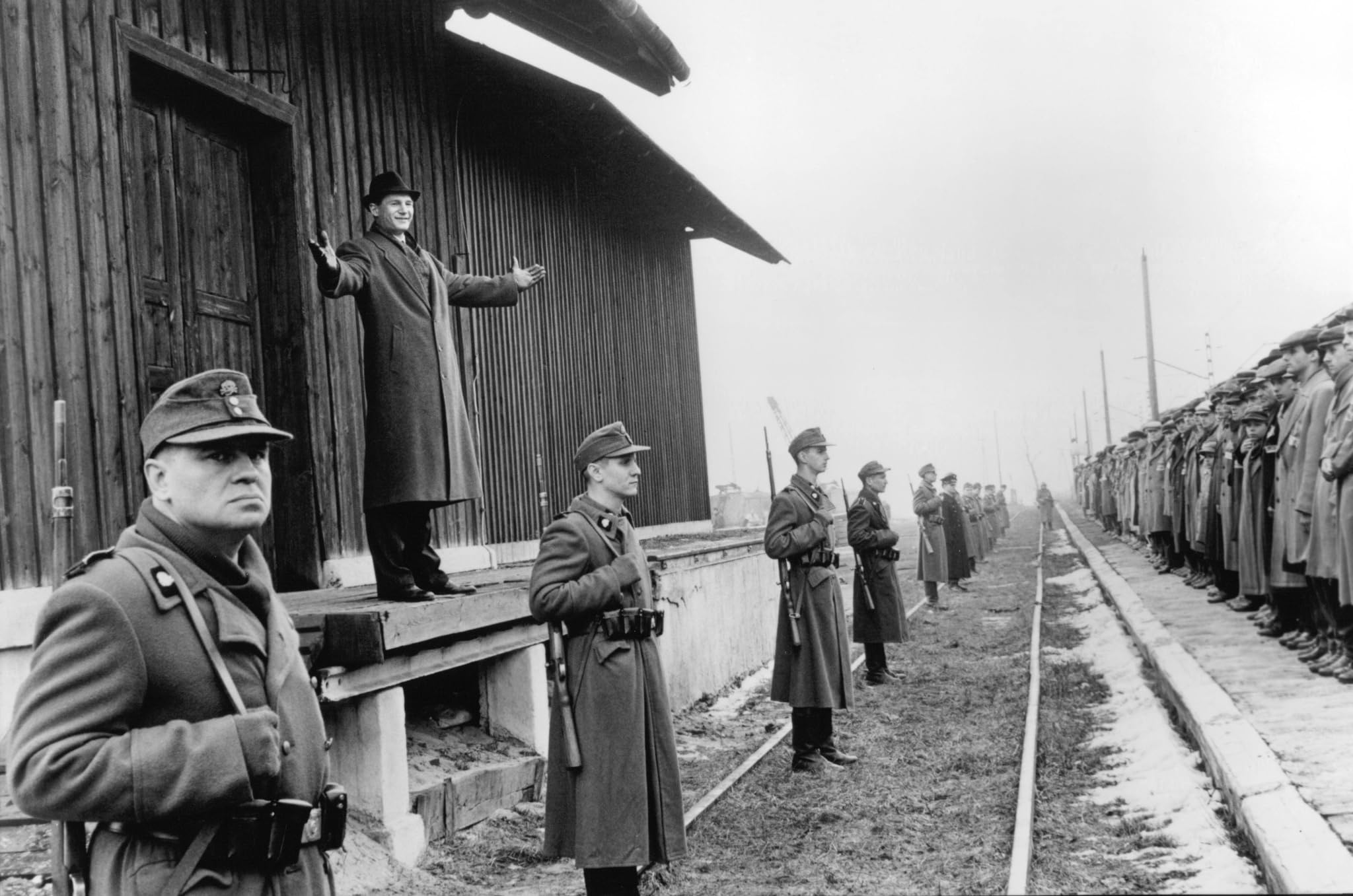
Main Cast
The performances here are not about virtuosity. They are about restraint. Neeson, Kingsley, and Fiennes each carry a different weight in this film, and none of them asks the audience for sympathy.
- Liam Neeson
- Ben Kingsley
- Ralph Fiennes
- Caroline Goodall
- Jonathan Sagall
- Embeth Davidtz
Awards And Recognition
Schindler's List won seven Academy Awards including Best Picture, Best Director, and Best Adapted Screenplay. It was the film that finally gave Spielberg the award recognition that had eluded him, but the victories feel earned rather than overdue.
- 7 Academy Awards including Best Picture, Best Director, Best Adapted Screenplay
- Best Cinematography (Janusz Kaminski), Best Original Score (John Williams)
- Best Film Editing, Best Art Direction, tied for Best Cinematography at the 1993 Oscars
- National Board of Review Best Film, BAFTA Best Film and Best Director
FAQ
Questions Readers Usually Have
These questions focus on the things readers usually want answered before committing to a three-hour film about the Holocaust: intensity, historical accuracy, age appropriateness, and whether the black-and-white presentation holds up.
Is Schindler's List based on a true story?
Yes. It is adapted from Thomas Keneally's 1982 novel Schindler's Ark, which tells the documented story of Oskar Schindler, a German industrialist who saved over 1,200 Jewish lives during the Holocaust by employing them in his factories.
How long is Schindler's List?
The theatrical runtime is 3 hours and 15 minutes. The extended cut runs approximately 3 hours and 16 minutes. There is very little difference between the two versions.
Is it appropriate for younger viewers?
The film is rated R for language, nudity, and graphic depictions of Holocaust violence. It is an essential historical document, but parents should carefully consider whether younger viewers are prepared for its content. Most educators recommend it for mature teenagers.
Why is it shot in black and white?
Spielberg chose black and white to give the film a documentary quality and to distance it from the polished look of typical Hollywood productions. It also mirrors the actual newsreel and photographic record of the period.
Who directed and wrote the screenplay?
Steven Spielberg directed. The screenplay was written by Steven Zaillian, adapting Thomas Keneally's novel. Zaillian won the Academy Award for Best Adapted Screenplay.
How many Oscars did it win?
It won seven Academy Awards: Best Picture, Best Director, Best Adapted Screenplay, Best Cinematography, Best Film Editing, Best Art Direction, and Best Original Score. It was nominated for twelve total.
Where was it filmed?
Principal photography took place in Krakow, Poland, over 72 days, including on location at the Auschwitz-Birkenau concentration camp. The Schindler Factory in Krakow was also used.
Is it considered accurate to the real events?
The film is widely regarded as historically faithful. Some dramatic compressions were made for narrative purposes, but the core events - Schindler's factory, the lists, Amon Goeth, the ghetto liquidation - are documented. Survivors consulted on the production.
Can I watch this without seeing the other films in a series?
This is a standalone film. No prior viewing is required. It is not part of a franchise.